
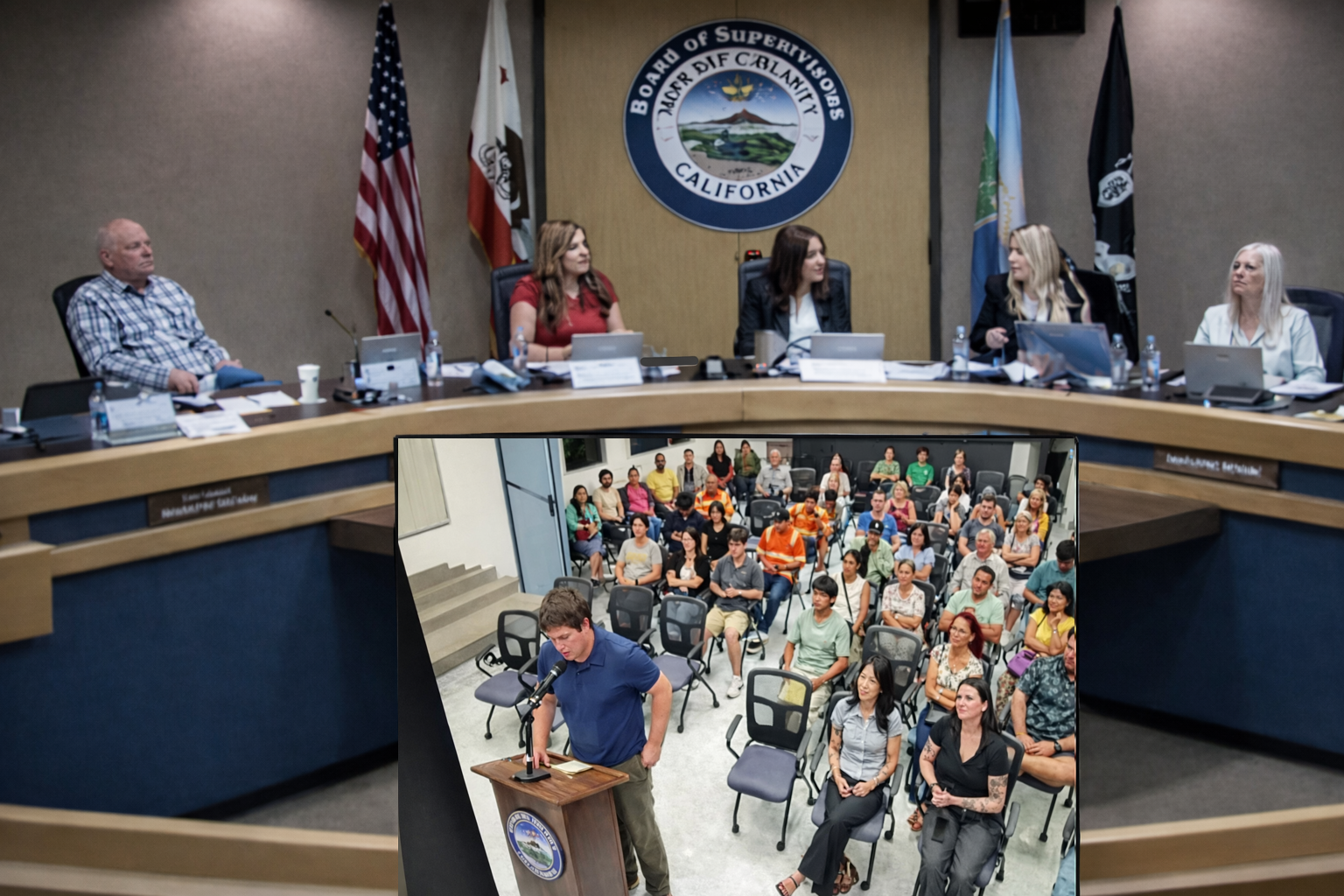
On March 26th, 2026, the Imperial Board of Supervisors had their special meeting regarding the data center. It lasted just over three hours, with dozens of speakers, and…zero vote.
The Imperial Data Center Project meeting was a packed, high-stakes public forum that made one thing painfully clear. This project isn’t just about jobs or infrastructure. It’s about trust. And right now, according to many residents, that trust is hanging by a thread.
What’s being proposed is the largest private investment Imperial County has ever seen. And, what’s being questioned is whether the community is being asked to accept it—without fully understanding what it brings.
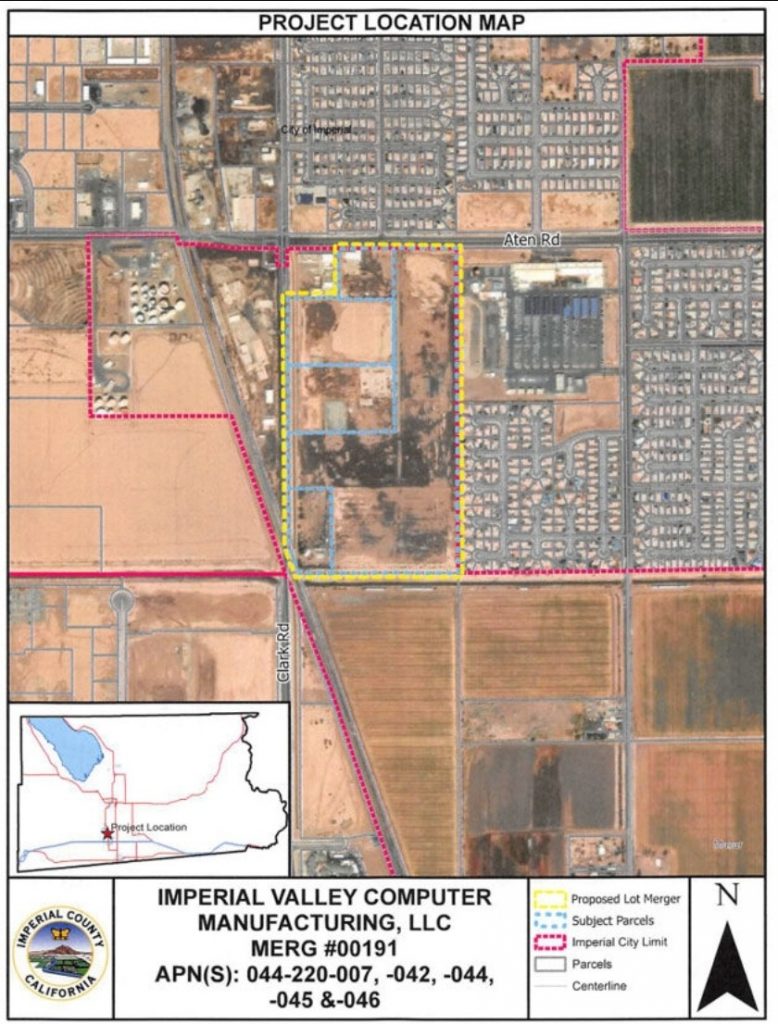
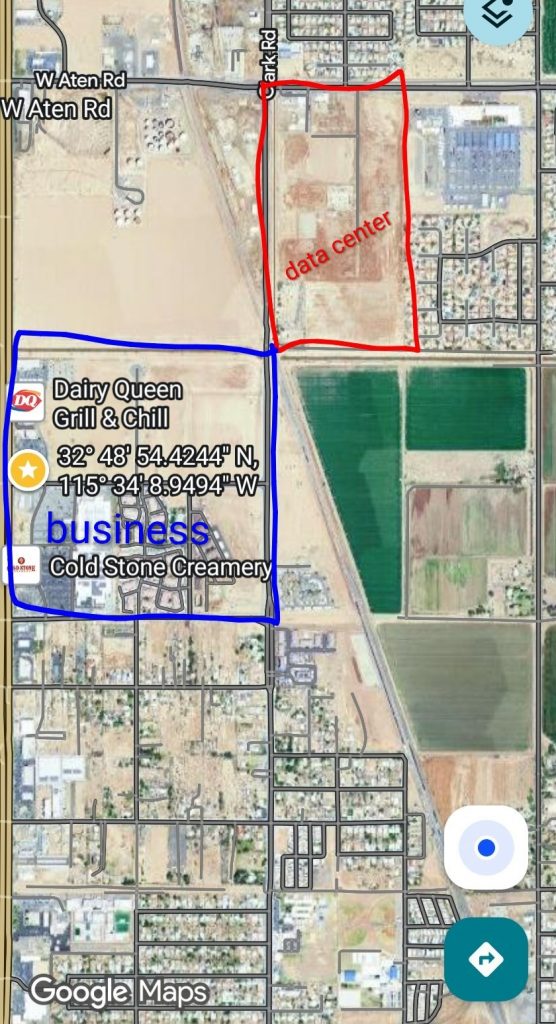
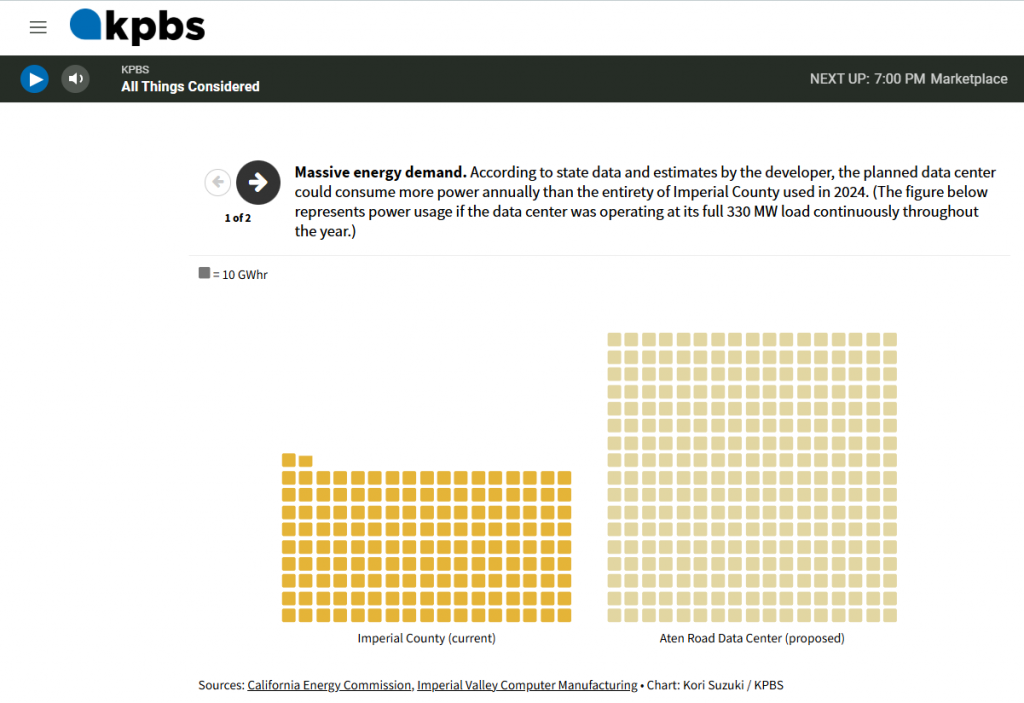
Developer Arevia Power, represented by Sebastian Rucci, wants to build a 200-megawatt data center campus on 104 acres on the north edge of El Centro.
Under this proposal, it becomes:
| Project Detail | Information |
|---|---|
| Developer | Arevia Power |
| Project Type | Data center campus |
| Power Capacity | 330 megawatts |
| Site Size | 74 acres |
| Location | North edge of El Centro |
| Data Halls | 8 |
| Substation | 230-kV substation |
| Battery Storage | Included |
| Backup Generators | 132 natural gas Caterpillar G3520 generators |
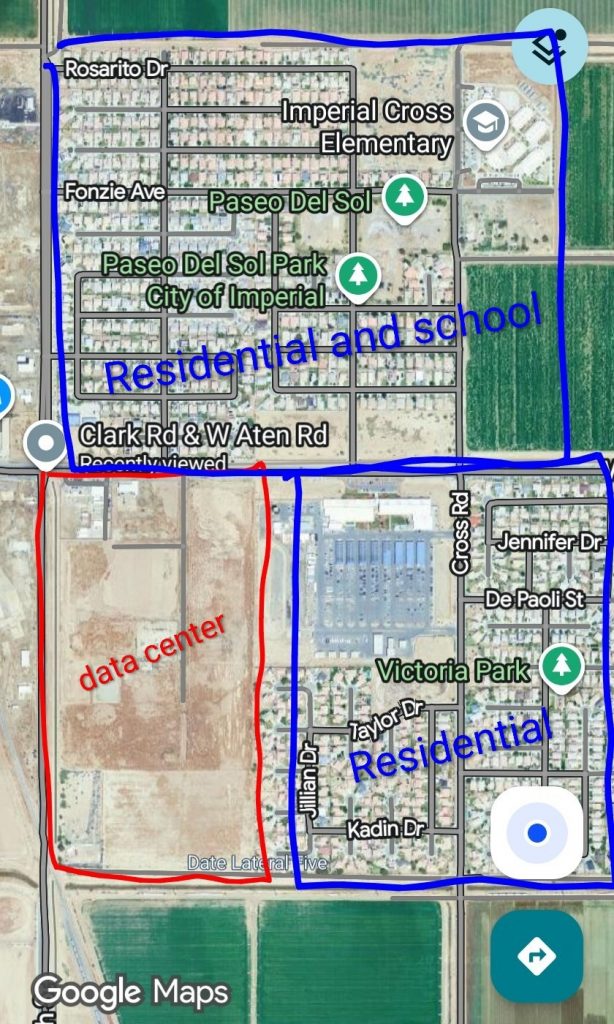
| Buffer from Homes | None |
| Estimated Cost | $2.8 billion |
Right now, that land is alfalfa fields and a forgotten rail spur.
On paper, it sounds like a lifeline for a region that’s been economically strained for years. However, the community isn’t just reading the numbers—they’re reading between the lines.
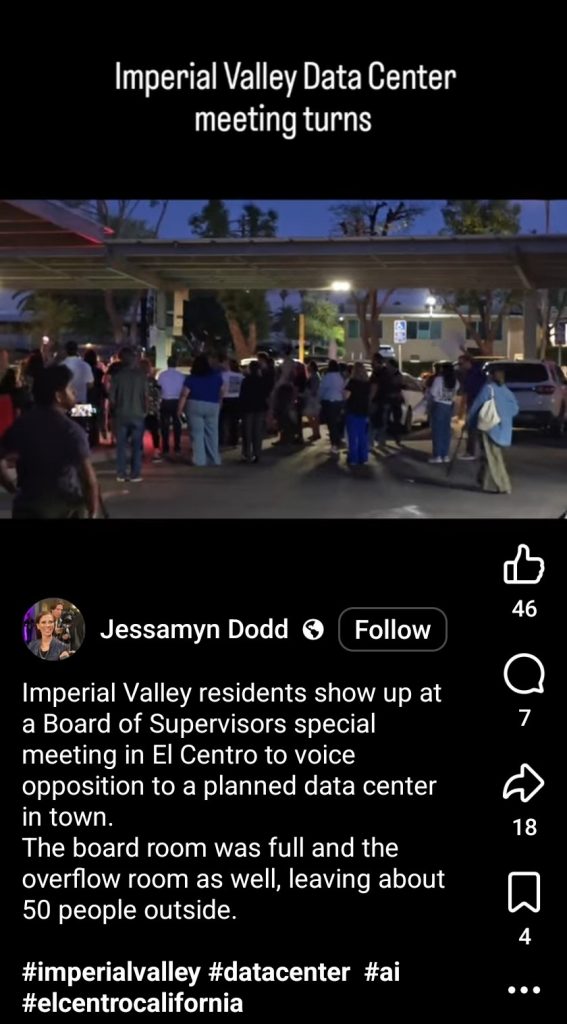
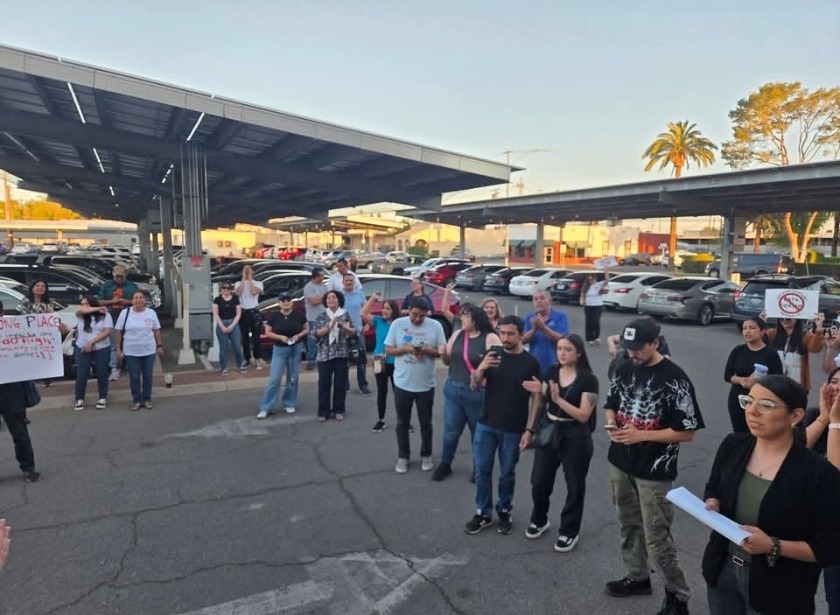
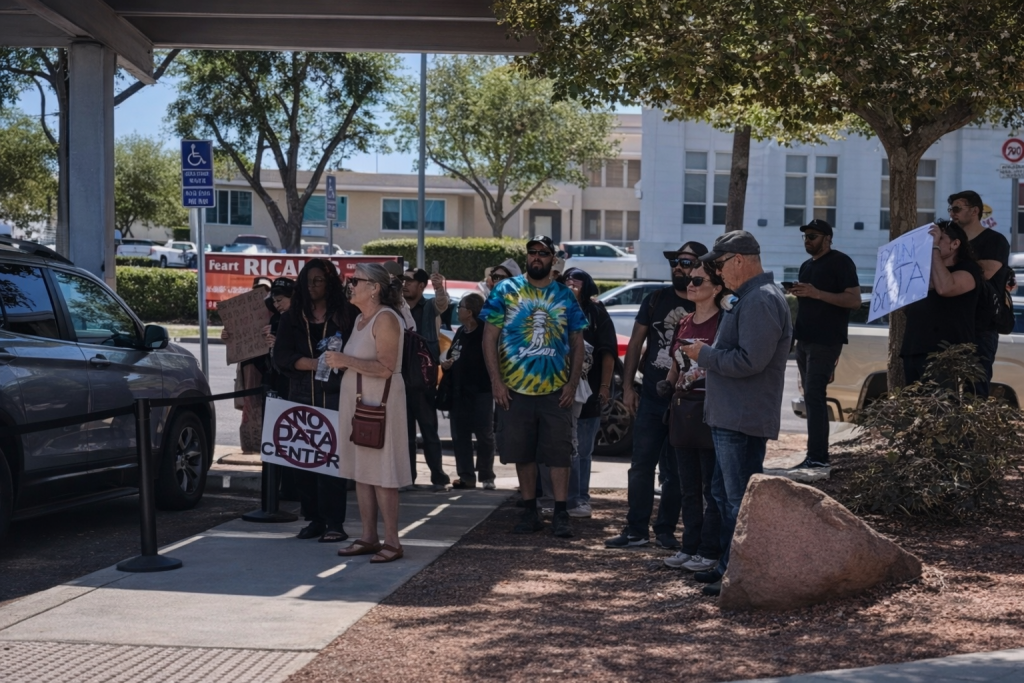
A screenshot of Jessamyn Dodd’s reel on Facebook showcasing residents outside the BoS meeting, as the board room was completely full.
Here’s where things exploded.
County staff and the developer are calling the project…
“Ministerial.”
A ministerial task (or project) is an administrative, routine, or operational duty performed by an official following set laws, rules, or instructions, requiring no independent judgment or discretion. These tasks are mandated, automated, or purely procedural, often indicated by terms like “shall” or “must” in legal contexts, distinguishing them from discretionary acts. In essence, if the project meets zoning rules, it gets approved. No deep environmental review required.
That means no full California Environmental Quality Act (CEQA) analysis. CEQA is a 1970 state law requiring state and local agencies to identify, disclose, and mitigate significant environmental impacts of discretionary projects. It ensures transparency and public participation in decision-making, aiming to prevent avoidable environmental damage. Data centers in California are currently facing intense scrutiny under the CEQA due to massive energy and water demands.
And this “no CEQA required” statement is where the room turned. Residents weren’t looking at paperwork—they were looking at the 224 diesel generators, the 950,000-square-foot requirement, the heavy water usage in a drought-prone region, and a facility running 24/7 next to homes and a school.
To them, calling this “ministerial” and “routine” felt absurd.
Speaker after speaker pushed back. Many said things like, “This isn’t a warehouse. This isn’t a small industrial site…
this is something
Entirely Different.”
The question then became unavoidable: How does a project of this scale skip environmental review?
The City of Imperial isn’t waiting around for answers.
They’ve already filed a lawsuit against the county, arguing the ministerial classification is legally indefensible and demanding a full Environmental Impact Report.
Their position is simple. They’re not against data centers. They’re against how this one is being pushed through.
That distinction matters—and it’s shaping the entire conflict.
After reviewing dozens of public comments, the concerns weren’t scattered—they were consistent.
Five themes kept coming up:
| Concern | Details |
|---|---|
| Water | In a region already struggling with groundwater depletion, the idea of a facility demanding massive daily water use hits hard. |
| Noise | The developer’s own model predicts noise just under the legal limit. Residents hear that and think, “So it’ll always be right at the edge.” |
| Air Quality | Diesel generators + cooling systems + existing health concerns = fear, especially for kids. |
| Contamination | Part of the site overlaps with a former hazardous waste location. That alone raises alarms. |
| Trust | This might be the biggest one. A gag order on staff, limited answers, and a feeling that decisions are being made quietly. |
People didn’t just show up worried about the project. They showed up worried about how decisions are being made.
The Developer Response: “We’ve Got It Covered”
Rucci tried to address the concerns head-on:
- Renewable energy through IID
- Future use of reclaimed wastewater
- Limited generator testing (30 minutes per week)
- Tier 4 emissions standards
- Noise-reduction enclosures
On paper, it’s a mitigation checklist.
In the room, it felt like something else:
Promises
Without
Guarantees.
| Developer Claim | Community Response |
|---|---|
| Renewable energy | No guarantees |
| Wastewater reuse | Not implemented yet |
| Limited generator testing | Still 224 generators |
| Tier 4 emissions | Still pollution concerns |
| Noise mitigation | Still near legal max |
And that gap—between what’s said and what’s secured—is where skepticism lives.
Not everyone is opposed.
UNITE HERE Local 1184 backed the project—with conditions:
They want a binding Project Labor Agreement ensuring:
- Local hiring
- Apprenticeships
- Fair wages
The economic argument is strong:
| Category | Value |
|---|---|
| One-time tax revenue | $182M |
| Annual property tax | $12.6M |
| 30-year net benefit | $379M |
| Construction jobs | 1,600–1,700 |
| Permanent jobs | 100–200 |
| Salary range | $85k–$120k |
Supporters see diversification, stability, and opportunity.
Critics see uncertainty, health implications, and increased noise.
Because those long-term jobs? They’re a fraction of the construction workforce.
And once the build is done, the question becomes:
Who actually benefits—and for how long?
Supervisors mostly stayed quiet.
Not because they didn’t have opinions—but because legally, they can’t show their hand yet.
When they did speak, their questions revealed something important:
They’re not fully settled on this either.
They’re asking:
Can we pause this?
Can we redefine projects like this moving forward?
Can additional health reviews be required?
That doesn’t sound like certainty.
That sounds like a board navigating pressure—from all sides.
What Happens Next
| Date | Event |
|---|---|
| March 26, 2026 | Initial BoS meeting (no vote) |
| April 7, 2026 | Second meeting (road vote) |
| Summer 2026 | Lawsuit expected |
| Fall 2026 (possible) | Construction could begin |
Right now, everything is still in motion:
- Permits are under review
- The lawsuit is heading to court this summer
- A ballot initiative is being discussed that could put projects like this in voters’ hands
And here’s the part that should get everyone’s attention:
If the project remains classified as ministerial, construction could begin as early as this fall without the full environmental review.
This isn’t just about a data center.
It’s about:
- How decisions get made
- Who gets a voice before they’re finalized
- And whether economic urgency outweighs environmental caution
Imperial County is being asked to make a choice.
Not just about development.
But about process, transparency, and trust.
And right now, that choice is far from settled. Because three hours turned into two meetings.
on April 7, 2026
…another meeting was held on discussing the approval of a road vacation, specifically Leimgruber Road.
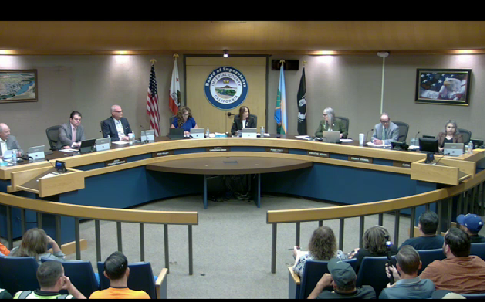
Dozens of speakers turned into a growing movement. What started as a controversial proposal is now something bigger: a legal fight, a political test, and a community that refuses to stay quiet.
After the explosive March 26, 2026 meeting, the Imperial Data Center didn’t fade into the background.
It escalated.
By the time the second meeting on April 7 started, it was already clear. This isn’t just a project anymore. It is a process under a microscope.
Before a single public comment was made, the tone was set.
Not casually or loosely, but formally. Repeatedly. Intentionally.
At the April 7 meeting, county officials laid out strict rules:
- Public comment capped at 30 minutes total
- Individual speakers limited to 3 minutes
- Additional comments pushed to the end of the meeting
- No “defamatory statements,” personal attacks, or disruptive behavior
- The county reserved the right to remove speakers
They didn’t just ask for order; they warned the room. And then came the logistics:
- Different colored comment cards (white, yellow, orange) for different agenda sections
- People required to line up in specific areas
- Overflow attendees not allowed to remain inside after speaking
- Some attendees reporting confusion about where and when to speak
Even before the issue was debated, participation itself had become complicated. The first speakers didn’t even get to speak freely. Several had to be redirected mid-comment, as people signed up for the wrong comment section, tried to discuss the lot merger and were told to wait, and moved between agenda items.
At one point, a speaker literally said:
“There was only…
one slip
to fill out.”
That moment mattered.
Because it showed something subtle, but important. The system wasn’t intuitive—even for people trying to follow it.
From the start, the tone wasn’t just concerned. It was charged, personal, and direct. Speakers didn’t just talk policy—they talked accountability.
We heard:
- Calls for recall campaigns
- Claims of behind-the-scenes coordination
- Accusations that the process was being pushed forward without transparency
- Direct appeals to individual supervisors—especially women leaders—to “do the right thing”
One speaker framed it as a defining moment:
“You have a choice…to be that role model.”
Another invoked constitutional rights:
“My right to speak…
my Right to
address
my Concerns to
my Elected
Officials.”
This wasn’t passive public input.
This was pressure—live, in the room.
At one point, the conversation wasn’t even about the project—it was about access. With elderly residents and others left standing outside in the heat, Supervisor Martha Cardenas-Singh pushed to open an overflow room. It was a small fix to a bigger problem: more people showed up than the process seemed ready to handle.
Then came the core issue: the lot merger.
And this is where things got complicated.
What the county clarified:
- The project involves merging five parcels into one
- Those parcels must be:
- Contiguous
- Not separated by roads or easements
- That’s why Leimgruber Road must be vacated
- Utility easements must also be removed or relocated
- The merger cannot be recorded until all conditions are met
Translation: Approval doesn’t mean immediate construction. It means conditional approval to move forward later.
That distinction matters legally.
But in the room?
It didn’t feel like a small step.
It felt like the step.
Item 14: Vacating Leimgruber Road.
| Step | Purpose | Dependency |
|---|---|---|
| Road vacation | Remove obstruction | Needed for merger |
| Lot merger | Combine parcels | Needed for project |
| Project approval | Enable build | Depends on both |
On paper, procedural.
In reality, pivotal.
County staff said it clearly:
- The road vacation is required for the lot merger
- The lot merger is required for the project
- If the lot merger fails → the road vacation fails too
So when the board voted on the road…
They weren’t just voting on infrastructure.
They were voting on momentum.
After poring through the meeting footage, I noticed that the concerns weren’t vague—they were specific, layered, and evolving.
| # | Topic | Details | Why It Matters |
|---|---|---|---|
| 1 | Timing and Process |
|
Residents questioned the timing and sequence of the process. |
| 2 | “Piecemealing” the Project |
|
Speakers framed this as a legal issue, not just criticism. |
| 3 | Environmental Concerns |
|
Development cannot proceed without DTSC clearance, and some land may not be suitable for human occupancy. |
| 4 | Health and Infrastructure |
|
Residents tied the project to broader public health and infrastructure problems already affecting the community. |
| 5 | Jobs—but for Who? |
|
Even neutral speakers questioned whether local residents would actually benefit. |
This is where PLAs (Project Labor Agreements) entered the conversation.
Additionally, there are some who claim that data center naysayers are spreading misinformation, and that the project will move forward no matter what.
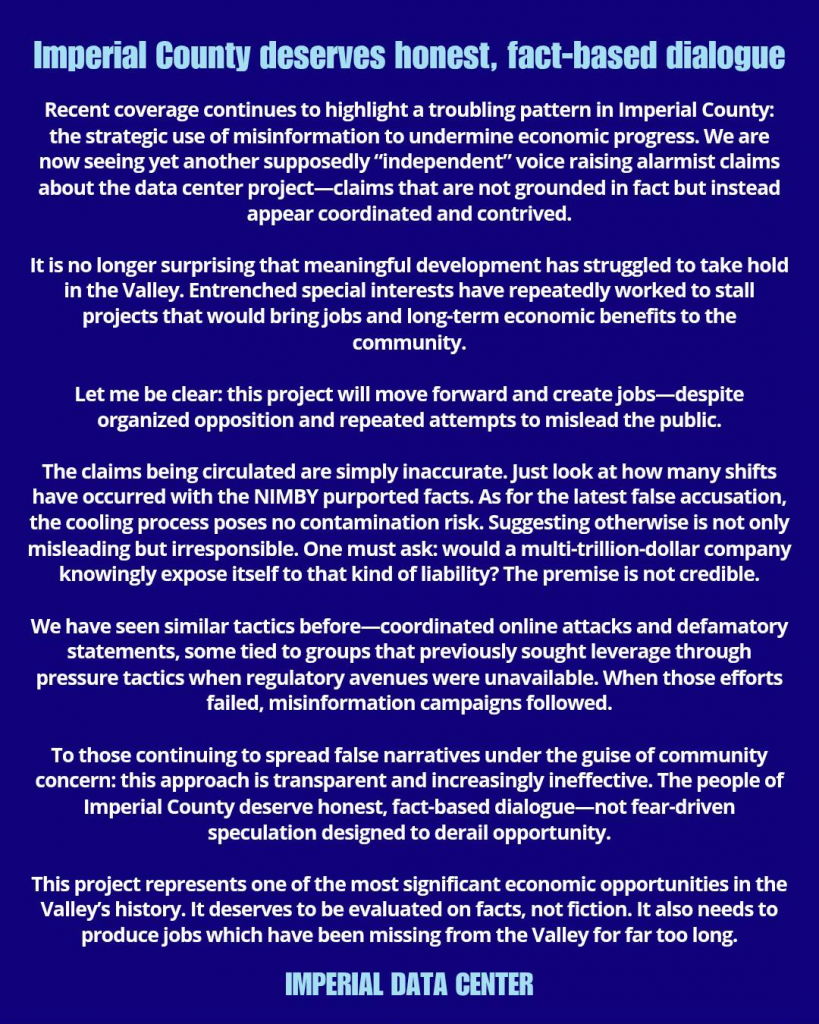
Let’s break that down, shall we? A recent paid advertisement in The Desert Review claims to defend the proposed Imperial data center by calling for “honest, fact-based dialogue.”
The ad repeatedly labels community concerns as “misinformation,” “alarmist,” and “coordinated.” Let’s pause for a second and look at what’s actually being claimed here. It’s clear that the contents of this ad don’t hold up under even a basic review of the two meetings.
Nothing about those meetings looked coordinated. A packed room, multiple perspectives, and concerns raised in real time—on the record—isn’t coordination. It’s exactly what public participation is supposed to look like.
So, let’s look at the facts:
- Residents raised concerns about water use, air quality, and proximity to homes
- The City of Imperial formally challenged the process
- Questions were raised about environmental review and project scope
- County staff themselves confirmed that multiple approvals are interconnected steps
Those are not fringe claims. Those are on-the-record concerns raised in public meetings. Disagreement is not misinformation.
The ad states: “This project will move forward…despite opposition”. That’s not a fact, that’s a position.
In reality, the lot merger is still under appeal. A lawsuit is ongoing.A ballot initiative is being discussed. Multiple approvals are still conditional. Nothing about this project is final.
Presenting it as inevitable doesn’t make it so—it just sidesteps the actual process.
The ad also dismisses environmental concerns by saying, “The cooling process poses no contamination risk…would a multi-trillion-dollar company take that risk?”
That’s not evidence, that’s an assumption. Large companies still undergo environmental review for a reason. Risk is not determined by company size—it’s determined by site conditions and safeguards.
At the meeting, concerns were raised about:
- water usage
- existing site conditions
- regulatory oversight requirements
No one credible is arguing “guaranteed contamination.” They’re asking for verification before approval. That’s the entire point of environmental review processes like CEQA.
The ad frames issues as Jobs vs. obstruction, and Progress vs. special interests. But at the meeting, the conversation was more nuanced:
- Some speakers supported development—but demanded local hiring guarantees
- Others asked for Project Labor Agreements (PLAs)
- Many weren’t anti-development—they were anti-process
That distinction matters.
Because asking, “Who benefits?” “Where are the guarantees?”…is not anti-jobs. It’s accountability.
The ad suggests opposition is manufactured or coordinated. However, what we actually saw says otherwise:
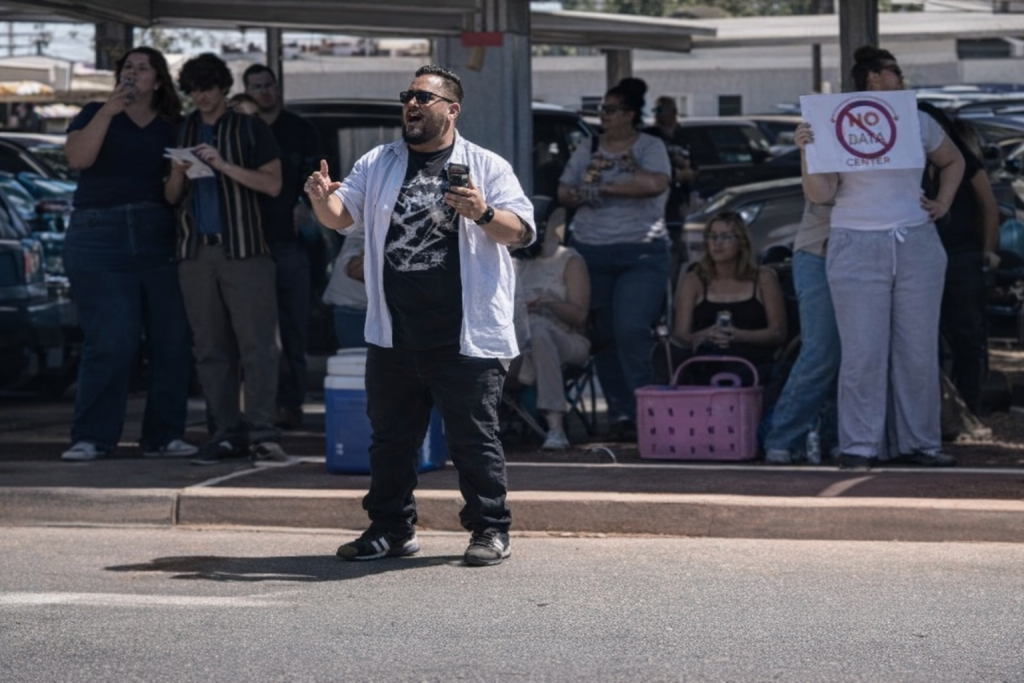
- Overflow crowds
- Residents unable to enter the chamber
- Written comments entered into record from over 20 individuals
- Speakers from different backgrounds raising different concerns
That’s not a coordinated script. That’s what public engagement actually looks like.
If the project is as strong as advertised, then the solution is simple. Conduct a full, transparent review. Address concerns directly. Provide binding guarantees where needed. Instead, what people are reacting to is this:
- Steps being approved individually
- A project described as “ministerial” despite its scale
- Key decisions happening before full public clarity
That’s where trust breaks down. Not because of “misinformation”, but because people feel like they’re being asked to accept something before seeing the full picture.
The ad ends by calling for “honest, fact-based dialogue.”
That’s something most people in this community would agree with. But dialogue requires acknowledging concerns, not dismissing them, and engaging them directly. Because labeling community members as misinformed doesn’t build trust.
It erodes it.
And if this project is going to move forward successfully, it won’t be because opposition was dismissed. It will be because concerns were addressed—and answered—with clarity.
Imperial County doesn’t need less questioning. It needs better answers.
The City of Imperial Enters the Room—Hard
One of the most structured arguments of April 7 was from the legal counsel for the City of Imperial.
Their key points:
- The project is massive—possibly the largest in California
- It’s located extremely close to homes (~200 feet)
- Noise, vibration, and air pollution concerns remain unresolved
- There are better locations available
- CEQA review is being avoided through fragmentation
- The lot merger is part of a larger project and should be evaluated as such
They didn’t just question the project. They questioned whether the board should even be considering it at this stage.
The Developer’s Side: Quietly Confident
The applicant’s representative kept it simple:
- The lot merger meets all legal requirements
- The parcels are eligible to be merged
- No new lots are being created
- Conditions will be met
No dramatic defense.
Just, “We meet the code.”
The Board: Technical, Careful, and Measured
Board members focused on specifics:
- Easements that must be removed
- Utility conflicts
- Environmental restrictions
- Timing of compliance vs approval
One key clarification: Conditions don’t have to be met before approval. They must be met before final recordation.
That distinction is legal.
But politically?
It’s exactly what’s making people uneasy.
At one point, a speaker was removed from the room.
Others were warned.
Applause had to stop.
The chair had to call for order—more than once.
This wasn’t just debate.
It was containment.
The Vote
Despite everything:
- Concerns
- Confusion
- Emotional testimony
- Legal arguments
The board, except Martha Cardenas-Singh, voted to approve the road vacation (conditionally)
Meaning:
- It only takes effect if the lot merger is approved
- But the path forward just got clearer
Where This Leaves Us
After two meetings, here’s what we know:
- The project is still moving forward
- The process is still being challenged
- The community is still divided—but engaged
And maybe most importantly: nothing about this feels small anymore.
Not the road.
Not the merger.
Not the meeting.
Because every “small” decision is starting to look like part of something much bigger.
The Real Question
Not:
“Is this legal?”
Not:
“Is this allowed?”
But:
Is this how
it should
Happen?
Update 4/12/26: Some reporting identifies generators using natural gas, while other official documents do not specify fuel type. Thank you to Rob Hollinger for steering us on the correct path.
People’s Press also thanks NIMBY, Imperial, for providing corrections regarding the data center requirements.
Below, a comprehensive summary of speakers and things that were argued on April 7, 2026 are detailed for the reader’s convenience:
Call to Order and Initial Proceedings
The meeting began with the consideration of agenda items. Item number two, concerning urgency items for closed session, was addressed with no additions. Following this, item number three, regarding closed session public comments, yielded no comments. A motion to convene to closed session was made and passed.
Reconvening and Roll Call
The board reconvened at 10 a.m. for their meeting on Tuesday, April 7, 2026. The roll call confirmed the presence of all supervisors:
- Supervisor District 1, Jesus Eduardo Escobar
- Supervisor District 2, Martha Cardenas-Singh
- Chairwoman Peggy Price, Supervisor District 3
- Supervisor District 4, Ryan Elliott-Kelley
- Supervisor District 5, John Hawk
Invocation and Pledge of Allegiance
The invocation was delivered by Eki, pastor of Western Avenue Baptist Church, who read from Jeremiah 9:23-24 and offered a prayer for wisdom, justice, and righteousness for the board and the county. This was followed by the Pledge of Allegiance.
Public Comment Procedures
The Chairwoman outlined the procedures for public comments.
Decorum and Safety Guidelines
A detailed statement regarding decorum and safety was provided.
- Adherence to room capacity, monitored by county fire.
- Designated standing areas for media, staff, and safety personnel.
- Information on how online participants could provide public comment via Zoom.
- Emergency exit procedures.
- Distinction between public comment periods (non-agenda items) and comments during action items or public hearings (specific to the agenda item).
- Use of colored comment cards (white for general public comment, yellow for action item 14, orange for public hearing) to help organize speakers.
- Instructions for those wishing to speak on multiple comment periods.
- Reiteration of the 30-minute limit for the general public comment period.
- Procedures for attendees speaking in person, including lining up along the right wall for the public hearing and leaving chambers afterward.
- Guidelines for respectful conduct, including no harassment, intimidation, personal attacks, discriminatory language, or disruptive behavior.
- The importance of waiting one’s turn and allowing others to speak without interruption.
- Enforcement of these guidelines, which could result in warnings, limited participation, or removal from the room. The Chairwoman issued a first warning regarding expected decorum.
Public Comment Speakers
Several individuals addressed the board during the public comment period. Speakers included:
- Sean Wilcoff
- Timothy Kelly
- Peter Rodriguez expressed concerns about decorum and the respect due to elected officials, also noting strong disagreements but the need for respectful discourse. He spoke about courage and unity, and highlighted potential issues with campaign finance disclosures. He also noted issues with campaign finance disclosures and mentioned a recall position for Chairwoman Price.
- Jake Tison spoke about the Imperial Valley Data Center Prohibition Act, its upcoming ballot measure, and his recent lawsuit filed by the data center developer. He also stated his intention to submit a multi-agency packet regarding the developer’s actions and informed the board that a recall position for Chairwoman Price was official and a signature campaign was underway.
- Christopher Scurries addressed Chairwoman Price, questioning the integrity of her “Woman of the Year” award and urging her to lead with integrity and courage, especially concerning the community’s future and her daughter’s well-being.
- Michelle Hollinger, representing Victoria Holmes, spoke about her company’s 35-year history of building homes in Imperial County and the negative impact the proposed project has had on her reputation and sales. She emphasized the importance of development for school construction and community growth.
- Lorena Minor-Montes expressed concerns about community safety and the county’s lack of a capable hospital. She requested the formation of an ad hoc committee to include community residents in decision-making and urged the board to ensure community input is meaningfully incorporated.
- Guillermo Hernández spoke about his reflections on the Constitution and his right to address elected officials. He raised concerns about potential health impacts on the community from development, referencing high unemployment and associated health issues like high blood pressure, heart disease, and cancer. He also stressed the importance of environmental protection.
- Ashley Contreras questioned the decision to close the overflow room and highlighted that many individuals present were not long-term residents. She urged the board to listen to local residents, create jobs for them, and invest in health rather than just survival, particularly for children.
- Hector Mesa stated he was not in favor or against data centers but spoke on the need for project labor agreements and local hire agreements to ensure the local workforce benefits from such projects. He emphasized the importance of apprenticeships, healthcare benefits, and pensions for tradesmen.
Agenda Approvals and Action Calendar
The Board moved through several agenda items:
- Item 8: Skipped and to be revisited if time permits.
- Item 9: Discussion of the agenda, with item 32 pulled for discussion.
- Item 10: Approval of the Consent Calendar passed.
- Item 11: Approval of the Consent Budget Calendar passed.
- Item 12: Approval of official proceedings for March 30, 2026, special meeting passed.
- Item 13: Skipped.
Several interruptions occurred, one of which regarded a “point of order,” leading to the removal of an individual from the room. Other people were also removed, including Jake Tison and a “Ms. Eidel”.
Action Item 14: Road Vacation
Discussion and Action regarding resolution of the Board of Supervisors ordering the vacation of road, right of way section of Leimgruber Road.
- Public Works Director’s Recommendation: The Public Works Department reviewed the technical aspects of the road vacation and found it in concurrence with the Subdivision Map Act and the Land Surveyors Act. Approval was recommended, but it was conditional upon the approval of the lot merger, as the road is still needed if the lot merger does not pass.
- Public Comments on Item 14:
- Peter Rodriguez noted a shift in the board’s approach to the topic and emphasized the need for decorum and honesty, expecting the same from elected officials as they expect from the public.
- Jake Tison raised concerns about the owner of the road having recently passed away and suggested waiting for the family to grieve. He also questioned the legality of the process under CEQA guidelines and warned of potential project shutdown.
- Christopher Scurries argued that vacating the road under these conditions constituted “piecemealing” the project, questioned the timing of the vote, and suggested the board was skipping vital steps. He urged a “no” vote, emphasizing the implications for the community and the potential for toxic dust.
- Michelle Hollinger presented information regarding contaminated parcels adjacent to the road right-of-way, citing Department of Toxic Substances Control findings of hazardous substances. She stated that vacating the road would necessitate its removal during future construction, which would be illegal due to the toxic substances.
- Ricardo Pacheco was called but did not speak.
- Brian Vega, Chair of the Imperial County Democratic Party, spoke about the land merger circumventing protective procedures and paving the way for industrial development. He highlighted the significant water and electricity usage and the potential loss of control over resources.
- Board Questions and Comments:
- Supervisor Cardenas Singh inquired about easements that would need to be vacated for a merger, referencing a certificate of compliance and code section 908080. She specifically asked about easements held by Southern California Gas. Public Works clarified that the applicant would need to approach companies with easements affecting the parcel and have them vacated as well, noting this is a requirement of the lot merger.
- Supervisor Kelly asked the Planning Department about the DTSC land use covenant and its implications for the property’s use, particularly if it was historically used for paint booth activity and required cleaning. He inquired about when clearance from DTSC would be needed. The department confirmed DTSC controls the land use and requires clearance before a building permit is issued, with specific restrictions on human occupancy.
- Motion and Vote: A motion was made by Supervisor Kelly, seconded by Supervisor Hawk, to approve Item 14, following the recommendation from staff. This approval was conditional upon the lot merger’s approval. The motion passed, with Martha Cardenas-Singh as the only “no” vote.
Item 15: Urgency Items and Public Hearing
- Urgency Items: No urgency items were presented.
- Items Pulled for Discussion: The pulled item (32) would be heard after the public hearing.
The board moved into the public hearing at 11:09 a.m.
Public Hearing – Item 17: Lot Merger Appeal
Planning Department Presentation: Jim Minnick, County Planning Director, presented Lot Merger 191, submitted by Imperial Valley Computer Manufacturing LLC. This project involves merging five individual lots, a road abandonment, and an easement abandonment for a future data center development. The property zoning is M1U (light industrial), AM2U (medium industrial), and A2 (general agriculture). Legal and physical access is proposed via Aten Road, Clark Road, and Leimgruber Road, with the latter proposed for vacation. The project was previously continued by the Planning Commission on December 18, 2025. Minnick detailed the lot merger requirements, including contiguous parcels, legal parcels, absence of easements affecting parcels, and no restriction of access. He emphasized that approval would be tentative or conditional, with conditions needing to be met at various phases, such as prior to recordation or construction. The recommendation was to hear all parties and consider approval or denial of items 1, 2, and 3 related to the appeals.
- Public Comments on Item 17:
- Tom DuBose, representing Imperial Valley Computer Manufacturing and the landowners, stated the lot merger meets all county code requirements and will conform with ordinances. He acknowledged the conditions regarding easements and road vacation, confirming agreement with them. He asserted that access would not be restricted and that no new lots would be created, only five parcels merged into one.
- Attorney Alene Taber, representing the City of Imperial, submitted a letter and highlighted concerns:
- Location Suitability: Questioned if this was the right location for the largest data center in California, given its proximity to residents and potential noise, vibration, and air pollution issues. She noted the proposed berm was not a definitive solution.
- Alternative Locations: Suggested that other more suitable manufacturing zone properties exist, referencing provided zoning maps.
- Compliance with Standards: Questioned why the data center wouldn’t meet standards for the Lithium Valley specific plan, such as renewable energy sources and carbon neutrality goals.
- CEQA Avoidance: Stated that CEQA is being avoided and that the lot merger should be part of a comprehensive CEQA analysis to understand full project impacts and allow for meaningful input.
- Disclosure of Impacts: Pointed out the lack of thorough disclosure regarding impacts and the absence of a condition requiring the retention of the DTSC land use covenant.
- She requested the board pause the process, deny the lot merger, and consider alternative locations.
- Statement on Public Hearing Comments: The Chairwoman read a statement clarifying rules for public hearing comments under the Brown Act, emphasizing that comments must be related to the lot merger and appeals, and that defamatory, threatening, harassing, or disruptive speech would not be permitted.
- Written Comments: A list of individuals who submitted written comments was read into the record. One of them was Attorney Alene Taber, legal representative for the City of Imperial.
- In-Person Speakers:
- Robert Hall (Alston) expressed appreciation for the board’s attention and stated that the land merger circumvents protective procedures and paves the way for further industrial development without adequate oversight, highlighting concerns about water and electricity usage.
- Claudia Contreras Harrington urged the board to deny the data center and associated lot merger, citing concerns about water and air quality, and the lack of a clear safety plan. She stated that the decision impacts health, families, and daily lives, and that communities are already experiencing the negative effects of such projects.

Licensed English tutor specializing in high school & college support — elementary students welcome too. ✍️📚
Buy me a Kofi: https://ko-fi.com/xolixia
read more from People's Press
 el centro’s education crossroads: evictions, enforcement & a new arts school—all at once
 dear local politicians: why cut ribbons when you could cut rent?
 how one family’s struggle exposes the gaps in america’s mental health system
data centers: elections have consequences
how one family’s struggle exposes the gaps in america’s mental health system
data centers: elections have consequences
 old glory, open doors, and one curious kid: a morning at el centro’s fire station
$5,000 for a kidney, $100,000 for a life: inside a borderland organ trade
old glory, open doors, and one curious kid: a morning at el centro’s fire station
$5,000 for a kidney, $100,000 for a life: inside a borderland organ trade