
This article was originally published by The Desert Review and is republished here for archival purposes.
BRAWLEY — A steady stream of people filed into Palmer Auditorium in Brawley to hear what animal behaviorist and Colorado State University faculty member, Dr. Temple Grandin, had to say about learning to thrive with Autism Spectrum Disorder (ASD), on the night of Tuesday, December 13.
As attendees exchanged warm hugs and hellos, some stopped just outside the lobby to support the FFA by purchasing hot chocolate and baked goods. “My mom made these,” remarked a young FFA member gesturing towards individually wrapped cupcakes. The importance of parent involvement was just one of the overarching themes present throughout the night.
As residents of all ages found their seats in the auditorium, Autism Support of Imperial County (ASIC) President James M. Gonzales could be seen shaking hands with those in attendance. The event began with a welcome by Brawley Mayor George Nava who praised Dr. Grandin both for her many years as an autism spokesperson and for her “worldwide notoriety” in agricultural science. In honor of her extensive contributions, December 13 was officially declared Dr. Temple Grandin Day. Following the celebration was a personal speech delivered by Holtville High School student Steven Hilfiker.
Speaking from his experience living with ASD, Steven wished to inspire others in his community by serving as an example of the potential of autistic youth. Mark Klaus, executive director of San Diego Regional Center (SDRC), then followed with a message about the non-profit’s core values of community, cooperation, and collaboration, all three of which seemed to be on display that evening.
Gonzales took the stage once more to deliver an emotional speech about the trials and tribulations of raising a non-verbal son, and the blessing it has been to have his ASIC family beside him. He expressed that the ultimate goal of this non-profit is to educate parents and encourage networking in order to ensure the lifelong success of autistic youths.
Keynote speaker Dr. Temple Grandin arrived on stage in her signature western button-up and neckerchief with enthusiastic applause from the audience. She wasted no time getting into the nuts and bolts of her life and career, seemingly full of advice on finding mentors in your community, using “back doors” to secure specialized industry jobs, and teaching children with ASD basic life skills. In her candid presentation, she explained the vital role of neurodivergent thinkers in ancient as well as modern society, and emphasized the difference between learning how to study versus learning how to work.
Grandin touched on the pressing issue of “skill loss” on a local as well as national level, suggesting that increased exposure to different trades and the arts may be a practical solution where conventional areas of study may fall flat for some children. At the close of her speech, Dr. Grandin encouraged audience members to ask questions, prompting parents, educators, and children alike to queue up with a range of inquiries.
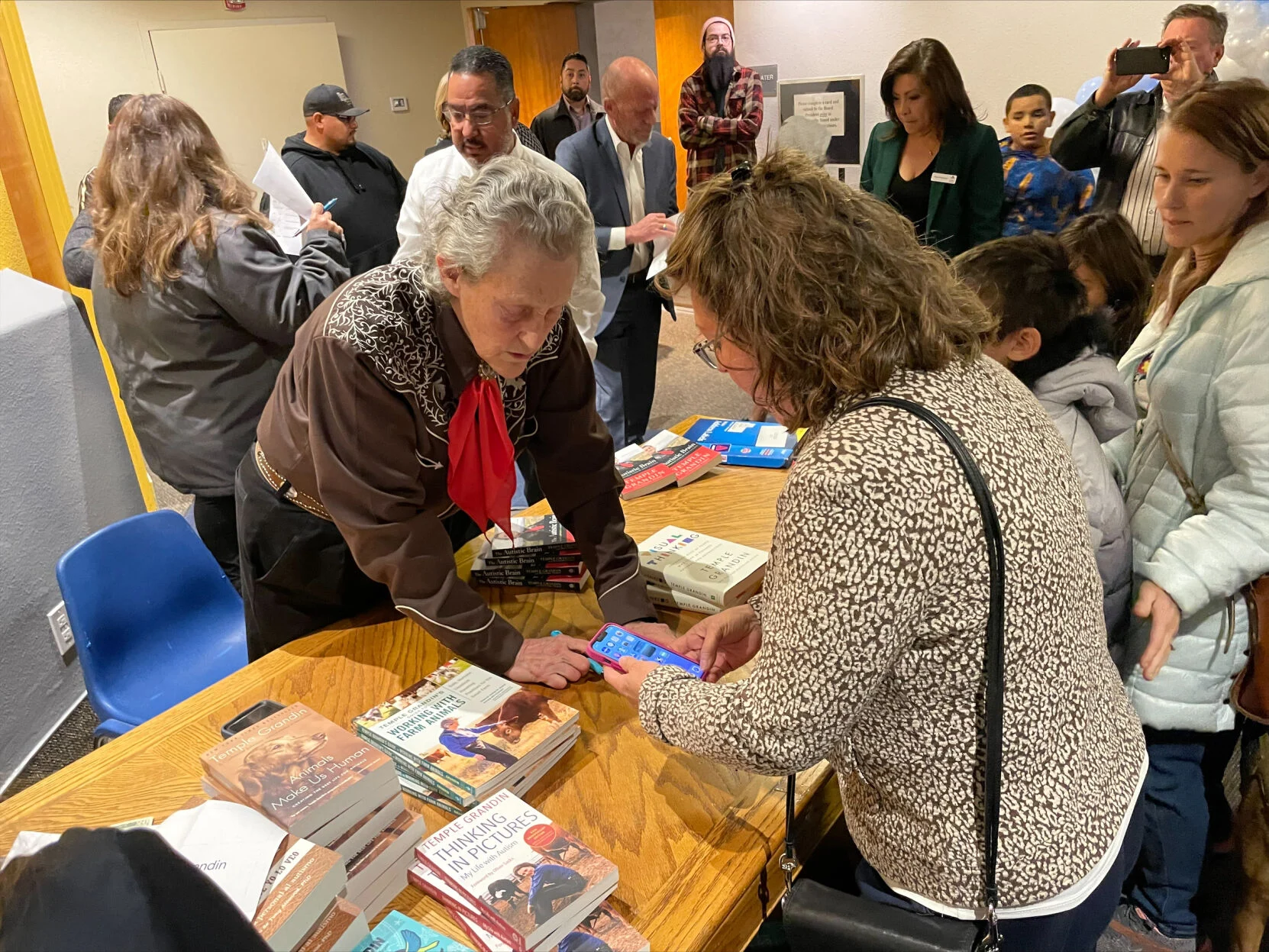
Back in the lobby, busy hands unboxed stacks of various books written by Dr. Grandin in preparation for signing and distribution. Her most recent bestselling book, Visual Thinking, attempts to bridge the gap between parent, child, educator, and business leader in the collective pursuit of tapping into neurodivergent potential. Attendees quickly formed a long line in anticipation of meeting with Dr. Grandin, some with support animals by their side and others with toy robotics in hand. “How did you get to be so smart?” one child asked. To that, Dr. Grandin explained that while she doesn’t know everything, she was able to find what she was good at and make it work for her.
She ultimately credits her success to her parents and closest mentors, much like those who made this momentous meeting of the minds possible.

Want to support Citizen Journalists like Sarina?
☕️ Buy Sarina a coffee! 😊
read more from People's Press
 who is gil rebollar: from halfway house to council chambers
 online deaf+ community expands and inspires
 a cultural affair: mid-winter festivities bring art, ag, and families together
 on dating latinas, hipsters in the hood, & what makes us different: wasapwu comedy kills at la fonda bar & grill
 vile or virtuous: liberal military vet + evangelical pastor speak on kirk
the future of la raza: remembering latino legacy & reassessing our identity
vile or virtuous: liberal military vet + evangelical pastor speak on kirk
the future of la raza: remembering latino legacy & reassessing our identity